
Martial Articles
This page is dedicated to anyone who wants to send in any features on karate and martial arts in general.
To submit articles, please send them as Word documents or in email, and any photos as jpeg's.
click here to send
By Phil Thompson, 4th Dan
 Traditional Karate-Do Federation Martial arts practice can be identified in documentation dating back nearly six thousand years in China. The transfer of information throughout the years coupled with individualization of its teachers has allowed development of many systems. Japanese empty hand martial arts are said to be founded out of necessity for survival due to a weapons ban.
It was through this necessity that empty hand martial arts were kept in secrecy and written information was not allowed. It was not until the early 1900's that concealment of training was felt to be no longer needed. At this time in history, the roots of Japanese empty hand martial arts were finally allowed to be analyzed. While there are many martial arts styles and systems, it is obvious that there are several techniques that traversed the bridge between the various systems. The following is a brief exploration of one of these techniques.
Reverse punch, or in Japanese, Gyaku-zuki (pronounced yaw-koo-zoo-key), can be found in Chinese, Korean, Japanese, and many other martial arts systems. While its application and formulation may be taught differently in various styles, its value as a mainstay technique is universal.
Master Gichin Funakoshi, known as the founder of modern karate and the Shotokan Karate System, believed that the mastery of the reverse punch was essential to any martial arts practitioner. Additionally, Master Funakoshi felt that reverse punch, while a very basic technique, will take years to master.
It is said that Master Funakoshi once stated "I have practiced reverse punch for over forty years, and I think that I am just beginning to understand it". Master Funakoshi's hypothesis of the reverse punch was founded in basic physics and anatomical dynamics principles.
He believed that utilization of the entire body to perform a technique, rather than a single body part or muscle group, would generate more power and stability of that technique. Essentially there is strength in numbers.
This premise is best proven through taking time to breakdown this technique to its simplest form.
The first step in understanding the reverse punch begins at ground level. As with building any withstanding structure, a strong foundation needs to be established. A proper stance, allowing firm contact and solid support of the feet to the ground is necessary.
This stance while firm and strong in nature, must allow freedom of movement and flexibility to facilitate effective completion of any technique. Shotokan practitioners are noted for their long stable stances and linear movements.
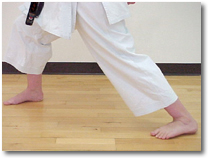 Front stance, (Zenkutsu-dachi), is commonly utilized to build strength and musculature while performing basic techniques. Front stance can be easily accomplished by; having the feet positioned shoulder width wide, two shoulder widths long (deep), the front knee bent (not farther than above the front ankle), the back leg straight, with all toes on both feet facing the front, the hips driven down and forward, and with the eyes and head facing the front.The center of gravity while in front stance should be maintained even in movement.
Training with a solid front stance allows the karateka to make an easier transition to a relaxed fighting posture.
This fighting posture can be utilized for tournament or self defense application.Once the feet are firmly planted on the ground and a strong stance is accomplished, the progression of this technique moves to the hips. The hips will be responsible for driving the chest, shoulder, arm and fist toward the target. To facilitate this, the hips must rotate toward the target while maintaining the same height within the stance. This rotation must be kept parallel to the floor.
Failure to add hip rotation decreases power and forces the muscles in the arm and shoulder to carry the burden of the workload.
Changing the height of the hip rotation slows the technique down and neutralizes the amount of power that can be generated. Hip rotation should continue forward with the technique until the chest and shoulders are positioned square with the target. Over emphasis of hip rotation causes unnecessary hip, back, and leg strain. Additionally, this over rotation will cause the target to potentially be missed.
Moving upward within this technique, the chest, shoulder and arm will move in conjunction with the hip rotation. The chest should swivel level with the floor, allowing the shoulder height to remain unchanged throughout this technique.
Shoulder tension, as with all muscle tension, should begin in a relaxed state, progress to a tense state only for the moment of impact, then immediately return to a relaxed state.
The ability to control this tension is key in performing any technique.
Breathing should be controlled and directed to the abdomen during this technique. Holding one's breath is not an option, as it decreases the ability to relax ones muscles through decreased oxygenation. The arms, as attachments to the shoulder, should remain close to chest, allowing the elbows to brush the side through the technique. The punching arm and the pullback arm work together in opposing directions,assisting the hips in their rotation.
Careful attention should be paid to the pronation and supination of the arms, completing these rotations just before impact. These rotations allow increased power though proper alignment of the bones and musculature of the arms and fists. Additionally, studies were done by Chinese martial artist Bruce Lee, that analyzed the importance of linear alignment of the shoulder and arm combination. These studies measured force of impact with different arm and shoulder alignments. Punches that went high, low, or off to the side generated less force that those punches that remained as a straight extension of the shoulder. The combined effort of the shoulder and arm muscles will hold the arm in straight alignment, while the hips and chest are squared toward the target. Thus the power that is generated from the lower body is transmitted to the upper body.
Finally, in the breakdown of reverse punch, the point of impact is reached. The fists are made into properly formed karate fists, with the thumb tightly compressing the first two digits. Both the punching hand and the pullback hand remains in straight alignment to protect the arms and wrists from potential injury.
Caution should be used to make contact with only the largest two knuckles on the punching hand. The fist should become an extension of the entire body.In essence, reverse punch, when properly performed, generates power and energy beginning at the ground. This energy passes through the legs, hips, chest, shoulder, arm, and fist.
Likewise, upon impact, the energy cycle is reversed back through the body to the floor. It is important to recognize that Newton's Law of Motion is applicable in this technique. Energy that is delivered to the target can be somewhat dispersed, but there will be some equal and opposite reaction as well. The body should be prepared to accept this energy return.In summary, reverse punch should be an anatomically correct technique. Through total analysis of reverse punch, it is easily seen that Master Funakoshi's hypothesis is correct.
The body as a whole will generate more power than utilizing one body part alone. Synchronization of the human body requires countless hours of training, and with close attention being paid to the details of each technique.
Anatomical dynamics and body alignment are required to allow the body to form a solid mass, thus allowing maximum power to the point of impact. All martial artists should recognize that training the human body to work in harmony is essential to development of the reverse punch.
Selected Readings
Karate-do Nyumon : The Master Introductory Text , Gichin Funakoshi, translated by John Teramoto
Dynamic Karate : Instruction by the Master, Masatoshi Nakayama, translated by Herman Kauz
Black Belt Karate, Jordan Roth, foreword by Tsutomu Ohshima
Bruce Lee's Fighting Method : Basic Training, Bruce Lee and M. Uyehara
Best Karate (Series), Masatoshi Nakayama
